regressioninc.math module#
Helpful arithmetic functions for complex numbers
- regressioninc.math.transpose(arr: ndarray) ndarray[source]#
Hermitian transpose of an array (transpose and complex conjugation)
- Parameters:
arr (np.ndarray) – Input array
- Returns:
Hermitian transpose
- Return type:
np.ndarray
- regressioninc.math.sum_r2(X: ndarray, y: ndarray, coef: ndarray) float[source]#
Calculate sum of square residuals
- Parameters:
X (np.ndarray) – The regressors
y (np.ndarray) – The observations
coef (np.ndarray) – The estimated coefficients
- Returns:
The sum of square residuals
- Return type:
float
- regressioninc.math.geometric_median(arr: ndarray) complex128[source]#
Calculate the geometric median for a 1-D array of complex numbers
https://en.wikipedia.org/wiki/Geometric_median
- Parameters:
arr (np.ndarray) – A 1-D complex array
- Returns:
The geometric median
- Return type:
Examples
>>> import matplotlib.pyplot as plt
>>> import numpy as np
>>> from regressioninc.math import geometric_median
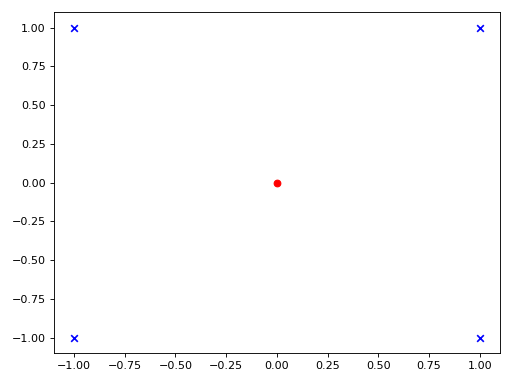
>>> arr = np.array([1 - 1j, -1 - 1j, -1 + 1j, 1 + 1j])
>>> med = geometric_median(arr)
>>> print(np.round(med, 6))
0j
>>> plt.figure()
>>> plt.scatter(arr.real, arr.imag, c="b", marker="x")
>>> plt.scatter(med.real, med.imag, c="r", marker="o")
>>> plt.tight_layout()
>>> plt.show()
(
Source code,png,hires.png,pdf)
>>> import matplotlib.pyplot as plt
>>> import numpy as np
>>> from regressioninc.math import geometric_median
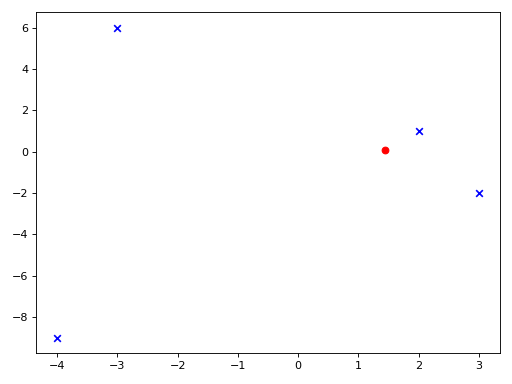
>>> arr = np.array([3 - 2j, -4 - 9j, 2 + 1j, -3 + 6j])
>>> med = geometric_median(arr)
>>> print(np.round(med, 6))
(1.444444+0.074074j)
>>> plt.figure()
>>> plt.scatter(arr.real, arr.imag, c="b", marker="x")
>>> plt.scatter(med.real, med.imag, c="r", marker="o")
>>> plt.tight_layout()
>>> plt.show()
(
Source code,png,hires.png,pdf)